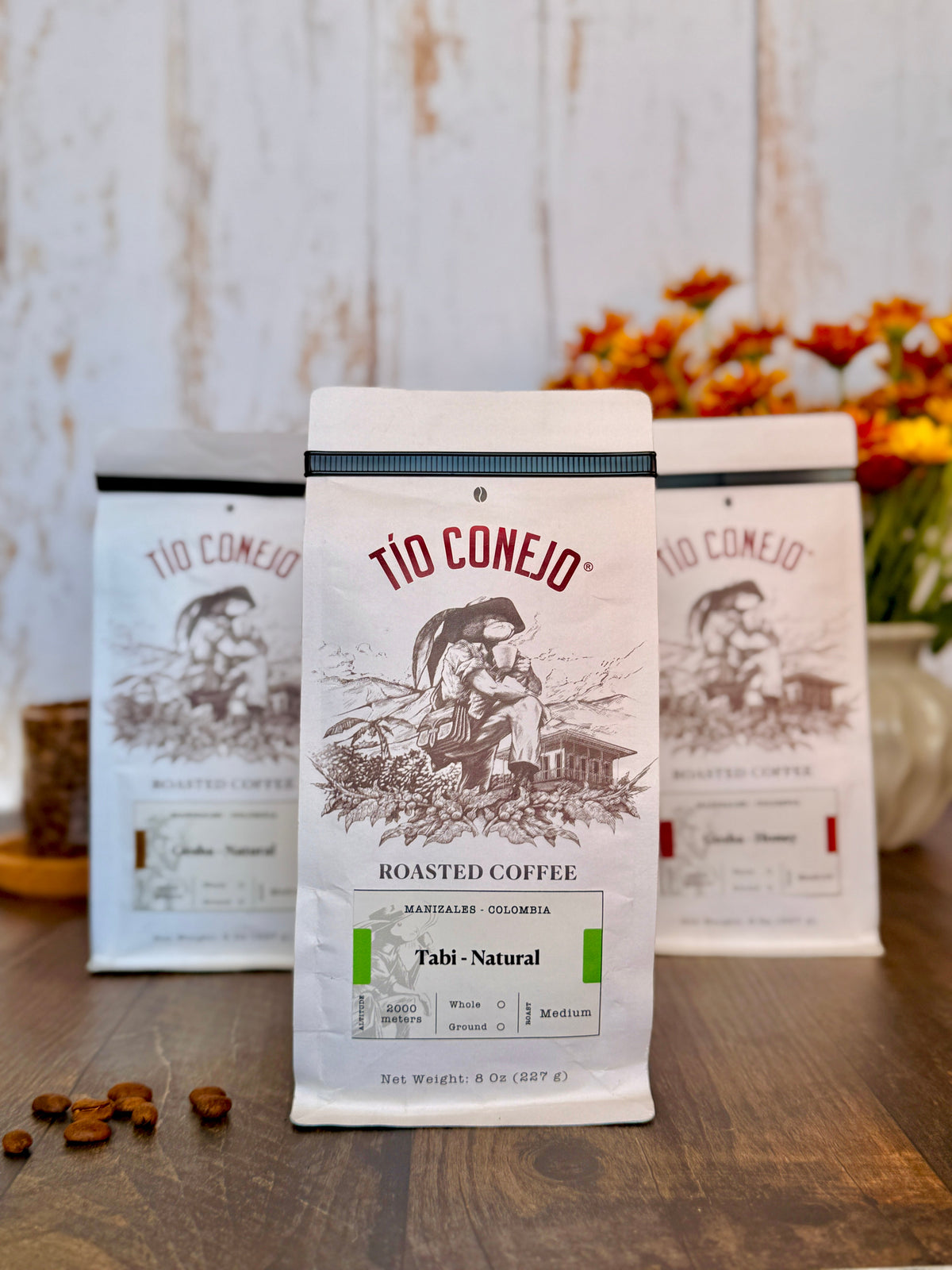
A smooth and sweet natural coffee, grown and roasted by us in the mountains of Manizales. Easy to enjoy, comforting, and quietly expressive.
Why we love Tabi
They say that in these mountains, not only coffee trees are born, but new stories as well.
Tabi is one of them — a variety created in Colombia and named by the Guambiano people, who with their quiet wisdom said: “Tabi means Good.”
And I’ll tell you something: it’s not just good… it’s delicious.
What you’ll taste
Processed naturally, this coffee opens with sweet fruit and playful spice, wrapped in a silky body that gently caresses the palate. Its bright malic acidity brings a fresh sparkle — like biting into a sun-warmed apple.
This is the kind of coffee that always feels right. Comforting, expressive, and easy to enjoy — like the visit of a good friend.
• Drink coffee every day • Enjoy smooth, sweet, balanced cups • Want something special without being overwhelming
Quantity
Couldn't load pickup availability
Origin and history
Developed by Cenicafé in 2002. "Tabi" means "good" in the Guambiano language. It was bred as a hybrid of Typica, Bourbon and Timor to stand up to leaf rust while keeping its quality in the cup. Its origin is tied to Indigenous communities.
The plant
Medium-tall plant, large leaves, resistant to leaf rust.
How we do it at Tío Conejo
We pick only ripe and overripe cherries, separate them by density in a siphon and sort by hand to remove defects. Natural process, dried slowly on raised beds.
Developed by Cenicafé in 2002. "Tabi" means "good" in the Guambiano language. It was bred as a hybrid of Typica, Bourbon and Timor to stand up to leaf rust while keeping its quality in the cup. Its origin is tied to Indigenous communities.